If software is solved, what remains is product.
This afternoon, I wanted to play Minecraft with my family.
I am in Baltimore. My wife and children are in Cameroon. We had a couple of hours together. The children have tablets. All we needed was to get everyone connected so we could play together.
Two hours later, we still hadn’t played Minecraft.
First, we needed Microsoft accounts. Then we needed to connect those accounts to a family. At one point, Microsoft sent me to a Microsoft 365 promotional page. At another, it told us an email address belonged to an existing account, except that the email was apparently only a recovery address for some other account we didn’t recognize.
Codes were entered repeatedly. Some expired. Eventually, we received a message saying we had reached the limit for that sign-in method.
My wife was exhausted. She kept asking why Microsoft needed so many codes. The children were growing impatient. I couldn’t even tell whether we were almost finished.
And I have been tinkering with computers for more than twenty years. My wife is a normal user who should never have to understand all these systems. There are millions of people like her.
Why should playing Minecraft require any of us to understand Microsoft’s account infrastructure?
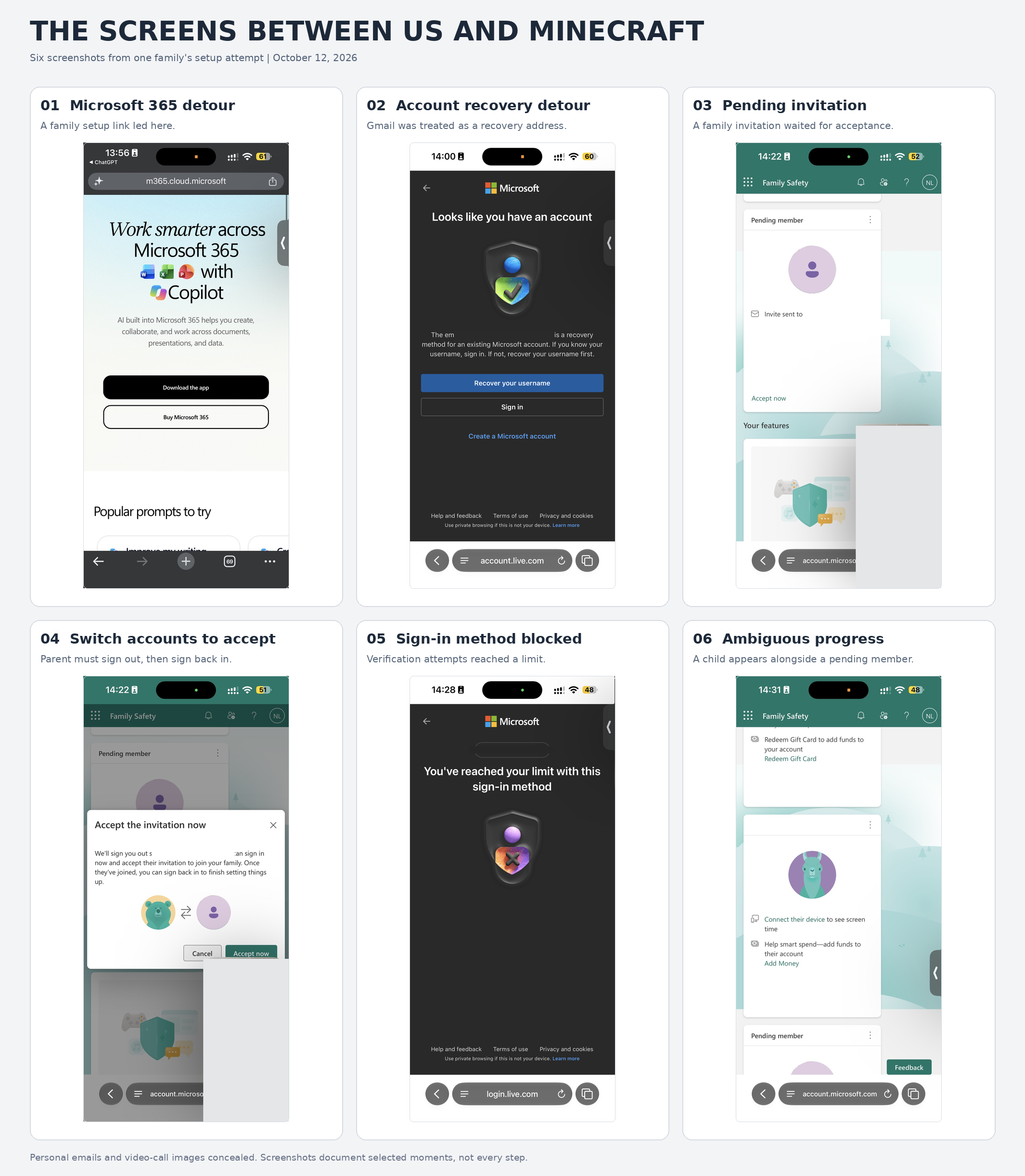
The problem is the product
The problem is that we couldn’t get to the game.
There are legitimate reasons for Microsoft to require parental consent, prevent unauthorized account access, and control who can interact with children in multiplayer games.
But why must the user experience all the complexity involved in implementing those protections?
Somewhere inside Microsoft, there are probably different teams responsible for identity, security, Xbox, Family Safety, and Minecraft.
Everybody inside the organization may have successfully completed their work. The authentication service works. The family invitation works. The security limits work. The parental permissions work.
And yet the family still cannot play Minecraft.
Who is responsible for that outcome?
This is something I’ve been examining in another piece, Good Agents (coming soon). Everybody inside an organization can be a good agent for the person or institution they answer to. They follow their instructions, meet their targets, and satisfy the people above them. Yet nobody necessarily takes responsibility for what happens to the customer at the bottom of that system.
Everybody is looking up. Who is looking at the whole thing?
How simple could this be?
If I were designing the onboarding experience, I would begin with the question: what is the user trying to accomplish?
Why couldn’t Microsoft give me a flow that looked something like this?
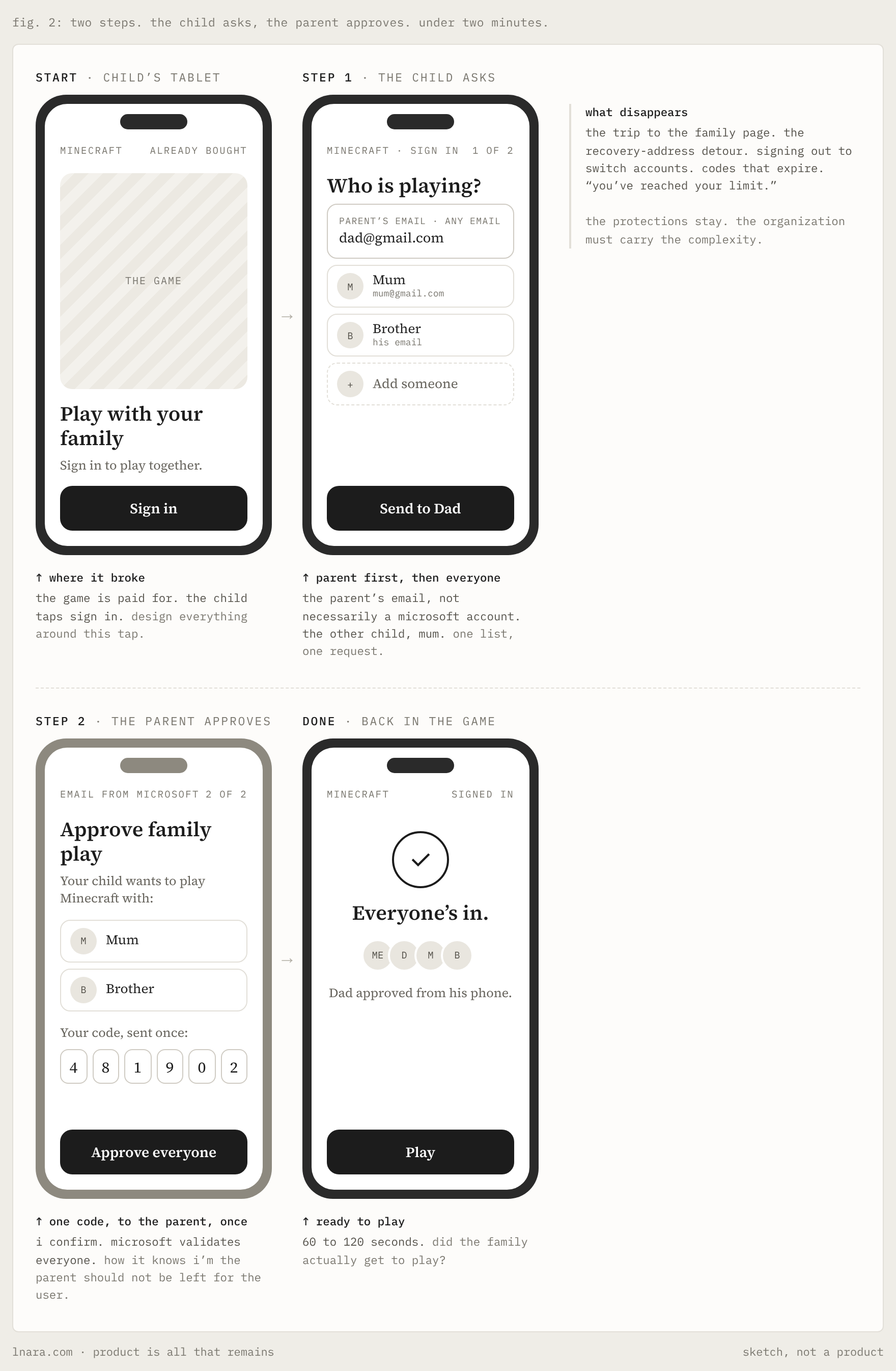
I would aim for a normal setup process that takes 60 to 120 seconds. If there is a genuine security exception, explain it clearly and preserve the progress already made.
The organization must carry the complexity.
If software is solved, why haven’t we solved this?
We keep hearing that software is solved. AI agents can write code, generate interfaces, implement features, and build applications at a fraction of the time and cost it once required.
If that is true, why aren’t we seeing dramatically better products?
I can imagine a product manager proposing twenty-six different versions of an onboarding flow, from A to Z, using agents to generate and evaluate them. Test the promising designs with actual families. And the test shouldn’t simply be whether an account was created or whether a security check passed.
Did the family actually get to play?
A personal agent as a wish granter
Eventually, I should be able to tell my agent that I want to play Minecraft with my family tonight.
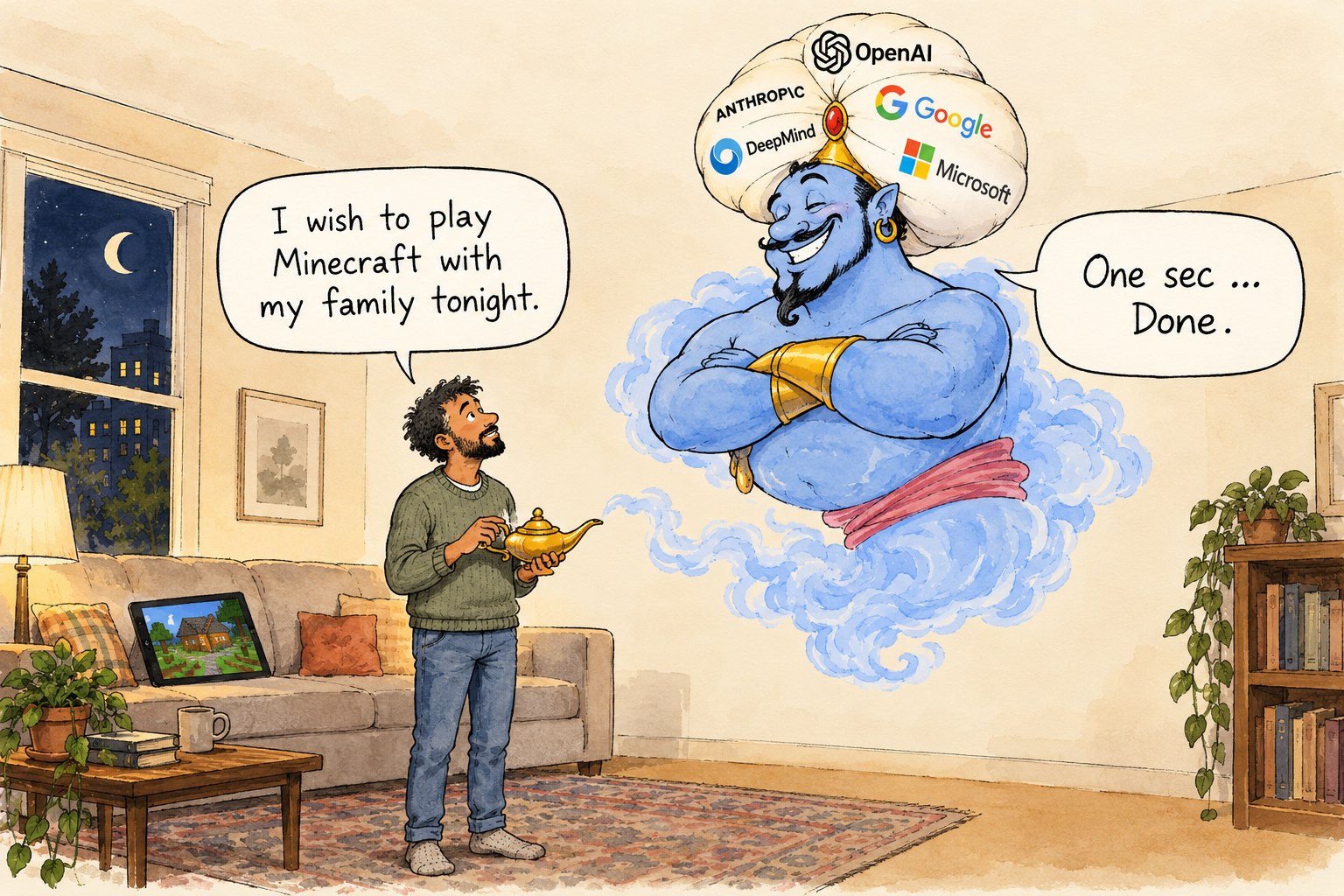
The agent should understand that intention, handle the necessary setup across services, and ask for my approval only when it genuinely needs me.
But why should we wait for personal agents to repair broken product experiences? The companies making the products already have access to the same extraordinary software-building capabilities.
If code becomes abundant, what matters is the ability to understand what people want, design the experience around that intention, and make the entire system deliver it.
This afternoon, I had two hours that I wanted to spend playing Minecraft with my children. Instead, I spent those hours navigating authentication screens.
When I talk about AI improving productivity, I think about those two hours. I think about what it would mean for technology to give that time back to my family.
That is the productivity I am looking for.
AI Agents
Part of the AI Agents collection, about intent, delegation, product design, and systems that deliver outcomes. The Software That Works series is a related thread.
- What Is the Last Good Software You Used?
- Anthropic Is a Model Company Pretending to Be a Product Company
In development:
- The 64-Stop Problem (coming soon): what happens when every participant follows their responsibilities but nobody owns successful delivery to the customer.
- Systems That Work (coming soon): how to design systems that work end to end for the people using them, absorbing organizational complexity instead of transferring it to the customer.
- Good Agents (coming soon): why individually responsible people, teams, and organizations can collectively produce terrible outcomes. Each serves its immediate principal.
- The Never-Ending Last Mile (coming soon): why even highly capable AI can fail to deliver a complete, trustworthy outcome, and why verification, integration, human judgment, and rising expectations keep moving the last mile.
These pieces are in development. I’ll link them here as they’re published.